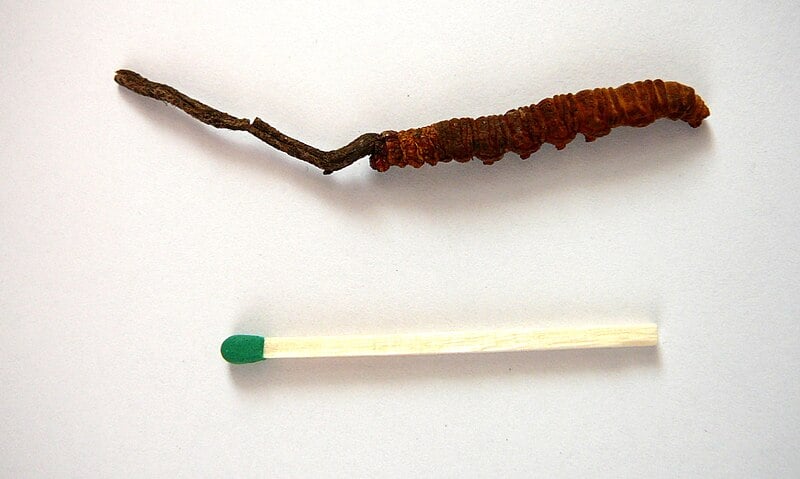
High in the Tibetan plateau, yak herders noticed their animals grew unusually energetic after grazing on a peculiar fungus. That fungus — Cordyceps sinensis, a parasitic mushroom that grows from caterpillar larvae — was eventually recognized as a powerful tonic and traded at prices exceeding gold by weight. Today, cultivated Cordyceps militaris makes these benefits accessible to anyone.
At a Glance
- Boosts VO2 max by +4.8 ml·kg⁻¹·min⁻¹ in 3 weeks — comparable to several weeks of aerobic training
- Increases mitochondrial ATP production by 30% after just 3 days of supplementation
- The functional mushroom with the strongest athletic performance evidence
- Always verify third-party heavy metal testing — contamination risk is real
Bioactive Compounds
Over 200 bioactive metabolites have been identified. The most significant:
- Cordycepin — an adenosine analog modified at the 3-position carbon; the primary bioactive compound
- Adenosine — higher concentration in C. militaris than C. sinensis; supports energy metabolism and vasodilation
- Beta-glucans and polysaccharides — cyclofurans, heteropolysaccharides, beta-mannans
- Ergosterol (pro-vitamin D2), nucleosides, amino acids, fatty acids
Cordycepin activates the TIGAR/SIRT1/PGC-1α signaling pathway — a master regulator of mitochondrial biogenesis. In controlled studies, Cordyceps supplementation produced a 30% increase in mitochondrial respiration and ATP production after just 3 days. This rapid cellular energy effect underpins most of its performance benefits.
Clinical Evidence: Athletic Performance and VO2 Max
Cordyceps militaris and VO2 Max (2017 RCT)
A randomized, placebo-controlled cycling trial in healthy adults:
- After 1 week: Time to exhaustion increased by +28.1 seconds vs. placebo
- After 3 weeks: VO2 max improved by +4.8 ml·kg⁻¹·min⁻¹ vs. +0.9 in placebo
A VO2 max increase of ~5 units is comparable to several weeks of moderate aerobic training — a meaningful gain from supplementation alone.
Cs-4 in Elderly Adults (2010 RCT)
A double-blind, placebo-controlled trial using Cs-4 (fermentation-derived C. sinensis) at 3–4.5 g/day showed significant improvements in VO2 max and ventilatory threshold in older adults — notable because VO2 max typically declines with age, and Cordyceps appears to slow or partially reverse this decline.
Chen S, et al. J Altern Complement Med. 2010;16(5):585–90. PMC3110835
Meta-Analysis
A meta-analysis across multiple Cordyceps studies found consistent, significant improvements in endurance performance and VO2 peak, with the most effective doses at 3–4.5 g/day and notably low heterogeneity across results.
Clinical Evidence: Anti-Fatigue and Mitochondrial Function
C. militaris fruit body extract has demonstrated a consistent anti-fatigue profile in preclinical models:
- Delayed time to exhaustion in swimming and running tests
- Increased liver and muscle glycogen content (more stored energy)
- Decreased serum lactic acid and lactate dehydrogenase (less fatigue signaling)
- Reduced blood urea nitrogen and creatine kinase (less tissue breakdown)
PMC4553310. Studies on the Antifatigue Activities of Cordyceps militaris Fruit Body Extract
2025 Update: Research in Nature Scientific Reports found that cordycepin combined with antioxidant compounds reduces exercise-induced fatigue more effectively than either alone — suggesting that antioxidant-rich diets may amplify Cordyceps' benefits.
Clinical Evidence: Sexual Function and Testosterone
Most evidence here comes from animal and in vitro studies, so clinical context is important:
- Cordycepin significantly increases testosterone production in Leydig cells via protein kinase A (PKA) activation — up to a 3-fold increase in cell models
- C. militaris extract improved erectile function, mating behavior, and testosterone levels in diabetic animal models
- C. militaris maintained androgen levels while inhibiting testosterone-induced prostate hypertrophy — potentially relevant for late-onset hypogonadism
PMC9333433. Functional study of Cordyceps sinensis and cordycepin in male reproduction.
Important: Human trials on testosterone and sexual function are limited. The mechanisms are plausible and animal data is encouraging, but these benefits await robust human trial confirmation.
Dosing Recommendations
| Purpose | Dose | Duration |
|---|---|---|
| Athletic performance | 3–4.5 g/day | 3–6 weeks minimum |
| General energy | 1–3 g/day | Ongoing |
| Elderly vitality (Cs-4) | 3 g/day | 12 weeks |
Buying tip: C. militaris (cultivated) is the only commercially viable species and is used in all modern clinical trials. Wild-harvested C. sinensis is prohibitively expensive and heavily adulterated in commerce. Choose products standardized to cordycepin content.
Safety Profile
Cordyceps has an excellent safety record. No oral LD50 has been established (very high safety margin), and clinical studies at 3.6 g/day for 3 months reported no adverse events.
Side effects (mild, uncommon):
- Diarrhea, constipation, or stomach discomfort
⚠️ Contamination risk: Two cases of lead poisoning have been linked to unverified cordyceps powder. Purchase only from suppliers who provide third-party heavy metal testing certificates. This is non-negotiable.
Avoid: During pregnancy or breastfeeding, with immunosuppressive medications, or with active autoimmune conditions.
The Bottom Line
Cordyceps has the strongest athletic performance evidence of any functional mushroom. The VO2 max improvements seen in controlled trials, combined with well-understood mitochondrial mechanisms, make it a compelling choice for athletes and anyone seeking sustained energy. Anti-fatigue effects are well-replicated. Testosterone and sexual function claims are mechanistically sound but still need robust human trial confirmation.
This article is for educational purposes only. Consult your healthcare provider before use.
Key References
- Hirsch KR, et al. J Diet Suppl. 2017;14(1):42–53. PMC5236007
- Chen S, et al. J Altern Complement Med. 2010;16(5):585–90. PMC3110835
- PMC4553310. Antifatigue Activities of Cordyceps militaris
- PMC9333433. Cordyceps sinensis and cordycepin in male reproduction
- PMC7824671. Cordyceps militaris decreases testosterone catabolism
- Sci Rep. 2025. DOI: 10.1038/s41598-025-92790-3