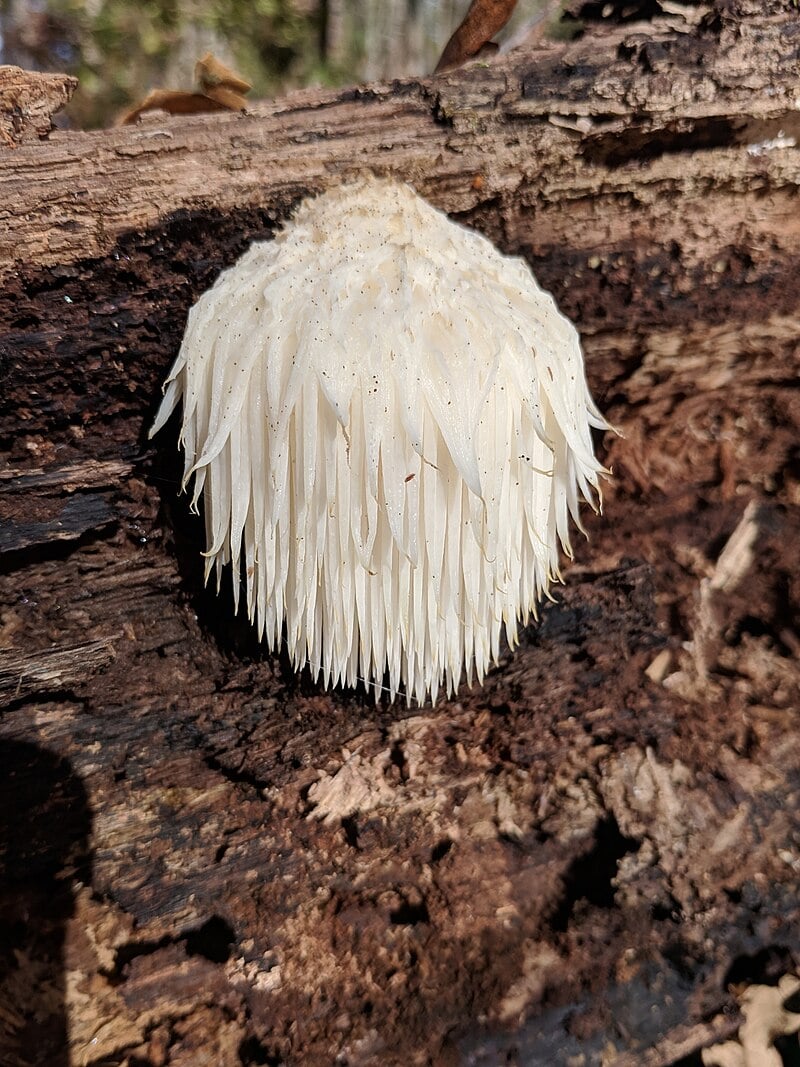
Lion's Mane (Hericium erinaceus) is unlike any other mushroom in the functional food world. Its shaggy white cascades have graced forest floors and traditional Chinese medicine cabinets for centuries — but modern science is revealing mechanisms that explain why healers valued it so highly.
At a Glance
- The only known mushroom that stimulates nerve growth factor (NGF) synthesis
- 2009 RCT: significant cognitive improvement in mild cognitive impairment after 16 weeks
- 29–39% improvements in mood, anxiety, and sleep scores in clinical trials
- Excellent safety profile with no documented liver toxicity
What Makes Lion's Mane Unique?
The mushroom produces two families of bioactive small molecules found nowhere else in nature:
- Hericenones (A–H) — aromatic compounds in the fruiting body
- Erinacines (A–K, P–S) — cyathin diterpenoids from the mycelium
Both are low-molecular-weight compounds believed to cross the blood-brain barrier. Their standout property: they stimulate the synthesis of nerve growth factor (NGF) — a protein essential for the growth, maintenance, and survival of neurons. Erinacines A, B, C, E, F, H, and I are particularly potent NGF inducers in cell and animal models.
Beyond NGF, Lion's Mane compounds have been shown to:
- Decrease amyloid-β plaque deposition in Alzheimer's models
- Increase expression of insulin-degrading enzyme (erinacines A and S)
- Activate the Nrf2 antioxidant pathway, upregulating SOD and glutathione peroxidase
- Mitigate neuropathic pain signals (erinacine E)
Clinical Evidence: Cognitive Function
Mild Cognitive Impairment (2009 RCT)
The most-cited human trial is a double-blind, placebo-controlled study of Japanese adults aged 50–80 with mild cognitive impairment. After 16 weeks of supplementation, the Lion's Mane group showed significantly higher scores on the Revised Hasegawa Dementia Scale at weeks 8, 12, and 16 compared to placebo. Importantly, the cognitive improvements declined after discontinuation — suggesting the effect requires continued use.
Younger Adults and Acute Cognitive Effects (2023)
A double-blind, parallel-groups pilot study in young adults (18–45) assessed acute and chronic effects at 1.8 g/day for 28 days. Results were mixed: some cognitive measures improved (faster Stroop task performance at 60 minutes post-dose), while others showed no significant change. Researchers concluded that larger trials with standardized extracts are needed.
Hericerin Derivatives and Hippocampal Neurogenesis (2023)
A mechanistic study in the Journal of Neurochemistry found that hericerin derivatives activate pan-neurotrophic signaling pathways in hippocampal neurons via ERK1/2, enhancing spatial memory performance in animal models. This work helps explain how erinacines translate to observable memory benefits.
Martinez-Marmol R, et al. J Neurochem. 2023;165(6):791–808. DOI: 10.1111/jnc.15767
Clinical Evidence: Anxiety and Depression
Menopausal Women (2010 RCT)
A 4-week trial in menopausal women found statistically significant reductions in depression and anxiety scores versus placebo — a short study, but the first double-blind trial of its kind on mood.
Overweight and Obese Adults (2019 RCT)
An 8-week trial in 77 overweight adults taking 1,200 mg/day found:
- 29.4% improvement in depression scores
- 33.2% improvement in anxiety scores
- 39.1% improvement in sleep disorder scores
The mechanism: Lion's Mane enhances pro-BDNF and BDNF production and promotes hippocampal neurogenesis — both pathways implicated in depression pathophysiology.
Clinical Evidence: Gut Health
A 7-day pilot trial (n=13 healthy adults) using 3 g/day found increased alpha diversity of gut microbiota, higher levels of beneficial Bifidobacterium and Bacteroides, upregulated short-chain fatty acid-producing bacteria, and downregulation of pathobionts. While small, these findings connect Lion's Mane to the gut-brain axis — a plausible additional pathway for its mood benefits.
Dosing Recommendations
| Purpose | Dose | Duration |
|---|---|---|
| Cognitive support | 3–5 g/day (fruiting body) | 8–16+ weeks |
| Mood/anxiety | 1,200 mg/day (extract) | 4–8 weeks |
| MCI trial doses | 1,050–1,200 mg/day | 16 weeks |
Buying tip: Look for products standardized to >1% erinacines (mycelium) or hericenones (fruiting body). Divided doses with food improve tolerability.
Safety Profile
Lion's Mane has an excellent safety record with no documented liver toxicity (LiverTox/NCBI).
Side effects (uncommon and mild):
- Digestive discomfort or nausea, especially at high doses
- Rare: skin rash or allergic reaction in mushroom-sensitive individuals
When to avoid or consult your doctor:
- During pregnancy or breastfeeding (insufficient safety data)
- With autoimmune conditions (immune stimulation may exacerbate symptoms)
- If taking immunosuppressant medications
The Bottom Line
Lion's Mane stands out because its mechanism — NGF stimulation — is unique, well-characterized, and biologically plausible. Human trials consistently show cognitive and mood benefits, particularly in populations with baseline deficits. Best viewed as a long-term neuroprotective supplement rather than a quick cognitive enhancer. Effects build with continued use and diminish without it.
This article is for educational purposes only and does not constitute medical advice. Consult a qualified healthcare provider before starting any new supplement regimen.
Key References
- Mori K, et al. Phytother Res. 2009;23(3):367–72. PMID: 18844328
- Docherty S, et al. Nutrients. 2023;15(22):4842. PMC10675414
- Martinez-Marmol R, et al. J Neurochem. 2023;165(6):791–808. DOI: 10.1111/jnc.15767
- Nagano M, et al. Biomed Res. 2010;31(4):231–7. PMID: 20834180
- Vigna L, et al. Evid Based Complement Alternat Med. 2019
- NCBI LiverTox. "Lion's Mane." NBK599740